For centuries, pearls have carried an aura of elegance, status, and quiet power. The Maharajas of India wore them as signs of royal prestige, and European queens draped themselves in luminous strands that glowed softly against their gowns. Even today, pearls continue to shape the language of luxury. At the 2018 Met Gala, celebrities appeared almost sculpted in pearls—Uma Thurman wore a gown sewn with more than 3,000 of them, while Rihanna stepped out in a papal-inspired look covered entirely in white and silver pearls. At the 2019 Grammys, Cardi B went viral for a couture outfit that made her look like a pearl emerging from an oyster.

Yet even these modern spectacles pale beside the value of one extraordinary gem: the natural pearl pendant once owned by Marie Antoinette. When it sold for $32 million in 2018, the world was stunned. Yes, its royal provenance mattered. Yes, the diamonds contributed. But the deeper truth is much simpler—and much rarer: It was a natural pearl.
The Rare World of Natural Pearls
Natural pearls form without any human intervention. They appear when a tiny organism accidentally enters the shell of a mollusk, triggering a slow and beautiful defense response: nacre, layered again and again until a pearl takes shape. The chances of this happening in the wild are astonishingly small, and the chances of the result being round, smooth, and luminous are even slimmer.

This rarity is one of the fundamental reasons natural pearls command such incredible prices. As Tom Moses of the Gemological Institute of America often explains, assessing natural pearls is one of the most complex tasks in gemology precisely because nature leaves so much to chance.
The Rise of Cultured Pearls
While natural pearls remain treasures of unpredictability, cultured pearls follow the same biological process—but with a nudge from human hands. Farmers gently open a mollusk and implant a tiny piece of donor tissue, giving the oyster a clear starting point for nacre formation. From there, nature takes over, and the oyster spends six months to two years building layer upon layer.

Even with this guidance, every pearl still grows in its own way. Some emerge perfectly round, others become baroque and strangely beautiful, and some never form properly at all. Cultured pearls became widely available in the early 20th century, thanks to Kokichi Mikimoto, who refined the method and introduced the classic round Akoya pearls that define much of modern jewelry.
Size, Color, and the Many Shades of Value
Not all pearls grow equally, and size is a major factor in value. Akoya oysters, known for their bright white pearls, produce smaller gems. South Sea oysters, however, can grow pearls that reach 15 or even 16 millimeters—large, luminous, and exceptionally rare. These strands often command tens of thousands of dollars.

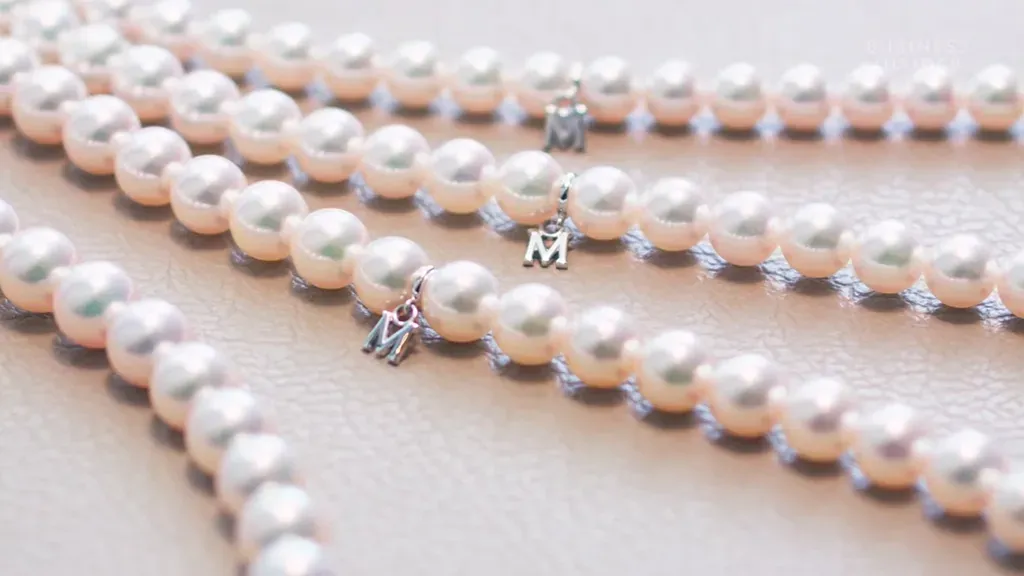
Color, too, depends on both nature and technique. Tahitian pearls are dark because the oyster that forms them has a naturally black inner shell. Akoya pearls remain white, but their overtones vary—from soft rose to subtle green. The pinker tones are generally preferred, giving the pearl a gentle, flattering glow.
Shape, Surface, and the Art of Perfection
Among pearls of similar size and color, shape becomes deeply important. Perfectly round pearls are remarkably rare, while baroque shapes—irregular and sculptural—offer their own kind of beauty but tend to be less valuable.

Surface quality also plays a role. The smoother a pearl’s exterior, the more highly it is prized. Tiny blemishes are natural, but a perfectly clean surface reflects an ideal combination of environment, time, and luck.
Luster: The Most Mysterious Quality of All
Perhaps the most captivating aspect of a pearl is its luster—the way it reflects and holds light. High-luster pearls have a mirror-like glow, as if illuminated from within. Low-luster pearls look muted or chalky in comparison. The difference lies in how uniformly the nacre layers form, like shingles aligned on a roof. When the layers are smooth and even, the pearl radiates. When they are rough or misaligned, the shine fades.

Gemologists at GIA rely on a library of reference strands to evaluate luster, because it is nearly impossible to judge a pearl’s glow without comparing it to another. This process highlights something essential: pearls cannot be understood through measurements alone. They must be seen and felt.
A Gem Born From Time and Chance
Every pearl—natural or cultured—is ultimately the product of biology, patience, and chance. Humans can guide the process, but they cannot control it. That blend of unpredictability is what gives pearls their mystique and explains why the perfect pearl remains as elusive and coveted as ever.
And so, if you ever bite down on something unexpectedly hard while enjoying oysters, don’t be too quick to toss it aside. It may be worth far more than a grain of sand.